Apor
An imaginary line cuts through Srinagar - the capital of Kashmir - dividing into a ying and yang

A lot has been written about Srinagar. It is the capital of Kashmir — one of the most hotly contested regions in the world. You know, we were almost on the verge of a war a few weeks ago. Apart from the news headlines, which are in plenty and mostly mispronounce the capital — Srinagar — that has been prominently featured in orientalist literature, which — like the Mughals — found an idyllic backdrop in the valley.
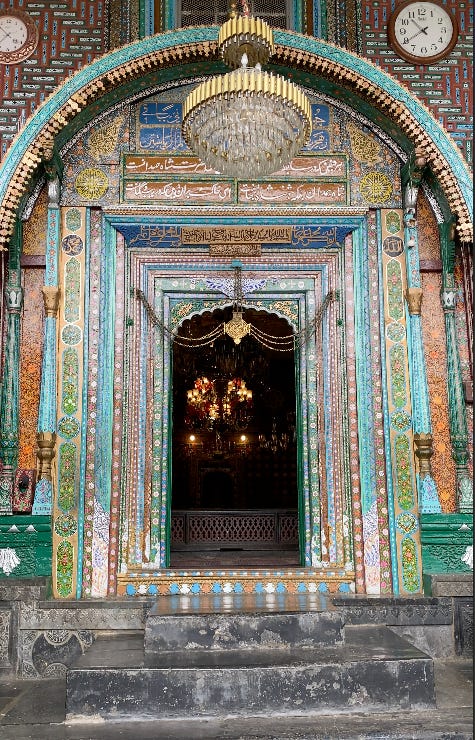
Ghulam Mohiuddin Sufi, a Sorbonne- and Columbia-educated historian from the mid-20th century, says that Srinagar essentially was Kashmir to the outside world. It kind of makes sense when you look at Srinagar’s history. Like outside of Hawal, the areas which border Razay Kadal and Goajwoar were called ‘Sarhad’—border. Or Batamalyun was essentially a village, as was Soura a few decades ago.
But over the years, with the rise in population, disturbances, and forced displacements, an enormous portion of the population moved out over the last 50–80 years, especially since the Tehreek.
Now many live across—apor, as we say here. Apor is just across the Amira Kadal bridge. Also known as ‘civil lines.’ The thing with this division across old cities in the world is that they really lack character, just like apor. It is basically an amalgamation of concrete, dusty roads, slender lanes, and size-zero by-lanes with a swarm of shops and a brick-brownish colour that runs until the city ends. It is the area of wealth. Most, if not all, rich bureaucrats, business families, and overseas Kashmiris find themselves located here.
You can’t really tell what the major difference is between Parraypur, Haydarpur, Sanat Nagar, Peer Bagh, Rawalpur, or Chanapur. They look alike, or at least look like versions of each other, depending on the affluence of the residents.
But back in the old quarters of Srinagar, things are different. The localities and neighbourhoods were built around temples, shrines, and mosques. And each area has a distinctness in their loudness, in their words, in their idioms, and in its swearing. In Khanyar, you will find people often swear by Dastgeer—a title given to Shaykh Syed Abdul Qadir Jeelani, whose shrine is in the area.
Closer to Khanqah, you will find people doing the same for Shah-e-Hamadan, who built the neighbourhood of Qutubbudinpur. Or in localities closer to Shaykh Hamza Makhdoom, you will find people swearing by the noble 16th-century saint. In the labyrinth of lanes and alleys, you will find small, subtle landmarks like the shrine of Muhsin Fani—the Kashmiri-Persian poet—or Mulla Akhund Shah’s seminary close to Rainawoar.
The city of Srinagar during the Sultanate period was divided into occupational zones. You had polishers—Roshangers—in one neighbourhood, the Tchaans—carpenters—in another. In one neighbourhood, you would find Kagazghar—the papermakers; in another, Koozgar—the alchemists. Sometimes you would find yourself in Kaed Kadal, a neighbourhood of Muslim jurists or Qazis, or some 10 minutes’ walk away, you would be in Qalamdanpur—the neighbourhood of pen-makers.
In those neighbourhoods, you would find a different set of words or metaphors used by Kashmiris. Like a carpenter would hammer you by saying, “bi waalai thaep”—I will hit you with a thaep (a carpentry hammer made of walnut wood), or someone in Puj Mohalla would often use colourful metaphors made of blades.
Each neighbourhood, as I said, has its colour. Even though affluent families from years of continuous displacement and the working class now find themselves on the outskirts, one in Civil Lines and the others in the new Sarhad around Illahi Bagh and Zakur, which were once pavilions for the royalty.
Both of them find themselves in shrines and mosques during Urs or Fridays. Mostly men and women of old age, who carry sath ti pazch, hope and belief that they will find salvation and spiritual boost in these sacred spaces, which their new pin codes deprive them of
Postscript:
A few weeks ago, an old man asked for a lift while returning from prayers at Jama Masjid. I asked him where he was going. “Qamarwoar,” he replied. I told him I was going somewhere closer. He asked if he could be dropped somewhere nearby. I asked where he was from. He said he comes to the Jama Masjid every other day, saying that he was born close to it and that he finds peace there. I asked how long he had been doing that. He said every week since he moved in 1996. By the time he told me these stories, I had reached Qamarwoar. In return, he offered what any Kashmiri across pin codes does—Duakhair.
The postscript made me tear up
A beautiful vignette.